“The Company Special: Rethinking Career Growth with OPTOTUNE”
In photonics, cutting-edge technology is no longer enough.
Companies that fail to build trust, purpose and real career opportunities will lose the people they need to innovate.
This is the first written interview in “The Company Special”, the SalesPro4U series spotlighting companies, technologies, cultures and career opportunities across Photonics, MedTech, Deep Tech and Semicon.
Vicky Sucarrat, HR Expert at SalesPro4U, speaks with Adrian Wethli, Vice President Human Resources at OPTOTUNE. The Swiss company develops tunable optical components and systems for applications ranging from imaging and machine vision to laser processing.
Adrian joined OPTOTUNE more than seven years ago as an HR Generalist. Today, he leads the company’s global HR activities, helping to shape its culture and continuously develop its HR processes. Outside his role, he also supports children with a migration background as a learning and integration coach.
In this interview, Adrian explains why transparency, psychological safety, horizontal career growth and modern leadership are becoming important competitive advantages in attracting and retaining talent.
1. Trust Before Titles
Vicky, SalesPro4U: You are a young VP in an industry that is often perceived as traditional. What does ”Modern Leadership” mean to you?
Adrian, OPTOTUNE: It starts with earning people’s trust.
You build trust by being transparent, listening carefully and giving honest answers – even when the answer is, “I don’t know.”
Leaders should also be willing to show vulnerability. At OPTOTUNE, we want people at every level to communicate as equals. We are moving away from old-fashioned, authoritarian leadership.
When employees feel trusted and know that making a mistake will not immediately be held against them, they are more willing to share ideas and concerns. That openness drives innovation.
2. Creating Psychological Safety
Vicky, SalesPro4U: “Psychological Safety” means that people feel safe speaking openly at work. How do you create that at OPTOTUNE?
Adrian, OPTOTUNE: Through consistent communication and regular opportunities to talk.
We hold monthly management updates and share detailed information about what is happening across the company. Every leader also has a weekly meeting of 30 to 60 minutes in which team members can raise any topic.
We maintain an open-door policy and actively ask employees for their opinions and concerns. But asking is not enough. Leaders must also respond and show that the feedback is being taken seriously.
Psychological safety grows when people are informed, listened to and involved. And, as mentioned before, if they know that it’s okay to be vulnerable and make mistakes.
3. Retention Starts with One Question
Vicky, SalesPro4U: How can leaders create a culture in which people genuinely want to stay?
Adrian, OPTOTUNE: My first question is always: “What does the employee actually want?”
Leaders often assume that someone who has been in a role for three years needs a promotion. But that person may want something completely different – experience in another department, lower pensum, more responsibility or a completely new role.
Motivation is highly individual.
The key is to ask – and then build a development path around the person rather than around assumptions.
4. Horizontal Career Growth
Vicky, SalesPro4U: Career development does not always mean moving upwards. What is “Horizontal Growth”?
Adrian, OPTOTUNE: Vertical growth is the traditional career ladder: moving from junior engineer to senior engineer.
“Horizontal Growth” means moving into another discipline. A technical expert might transition into leadership, while an experienced manager might move into project management or return to a specialist role.
Such a move may not immediately result in a higher title or salary. However, it expands the person’s skills, perspective and internal network.
It is a win-win. The employee remains motivated by learning something new, while the company develops a more agile and connected workforce.
Vicky, SalesPro4U: How can companies make “Horizontal Growth” more attractive?
Adrian, OPTOTUNE: We are still working on that. It requires constant communication and encouragement from leaders.
The most powerful approach is to share real examples. We actually have a great case right now where someone in a Head of Engineering role is making a lateral move into a Principal Engineering position.
Some people initially ask why someone would make such a move. That reaction shows how deeply the traditional career ladder is still embedded in our thinking. We need to demonstrate that changing direction can be progress too.
5. Bridging the Generational Gap
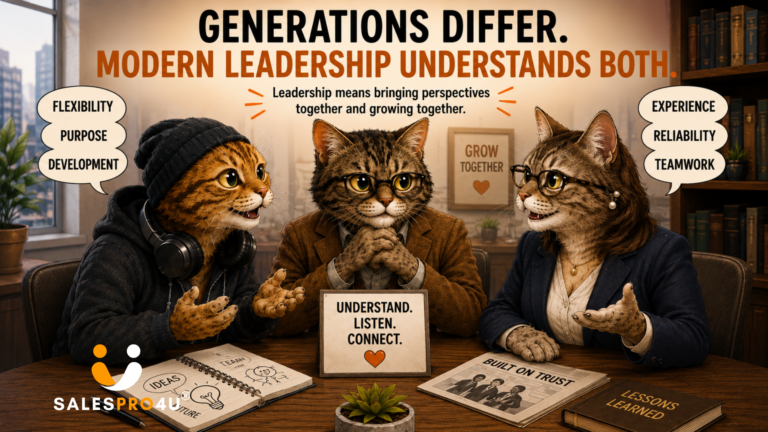
Vicky, SalesPro4U: Younger employees often expect more trust, flexibility and purpose. How can experienced leaders adapt?
Adrian, OPTOTUNE: First, leaders need to understand and accept that generational differences are real.
Many experienced leaders grew up with a work culture centred on working hard, earning more and climbing the hierarchy. Younger professionals may define success and motivation differently.
At the same time, younger employees still want to be recognised as committed and hardworking.
Our Leadership Academy helps leaders lead with purpose, communicate transparently and offer greater flexibility. This is especially important in photonics, where companies often manufacture highly specialised components rather than familiar consumer products.
Leaders must help employees to show how their work contributes to something bigger.
And ultimately, purpose, trust and flexibility are not only important to younger generations. Most experienced employees value them too.
6. Keeping High-Potential Talent Engaged
Vicky, SalesPro4U: OPTOTUNE has around 200 employees worldwide and a relatively young workforce. How do you keep young talent engaged?
Adrian, OPTOTUNE: You have to be proactive.
Young professionals need opportunities to change projects, take on new responsibilities or move into different roles.
Managing this is more demanding than running a static team, but without these opportunities, many young people will leave after two years.
Our goal is to retain people for six, seven or more years by continuously offering new experiences.
Fortunately, our customers and technologies are highly diverse. Engineers can work on very different applications without leaving the company. The greater challenge is not boredom. It is managing workloads and preventing burnout when people move quickly between demanding projects.
7. Why People Leave Photonics
Vicky, SalesPro4U: Why do professionals leave, and how can photonics become more attractive?
Adrian, OPTOTUNE: Based on our exit interviews, most people leave for personal reasons. They relocate, start a family, move abroad or choose a completely different career.
I cannot remember anyone leaving because they disliked photonics itself.
The challenge in Switzerland is that the industry is geographically spread. In some regions, there may only be two or three photonics companies. Changing employers can therefore mean a long commute or relocating the whole family.
The industry itself is fantastic. We simply need to make it more visible.
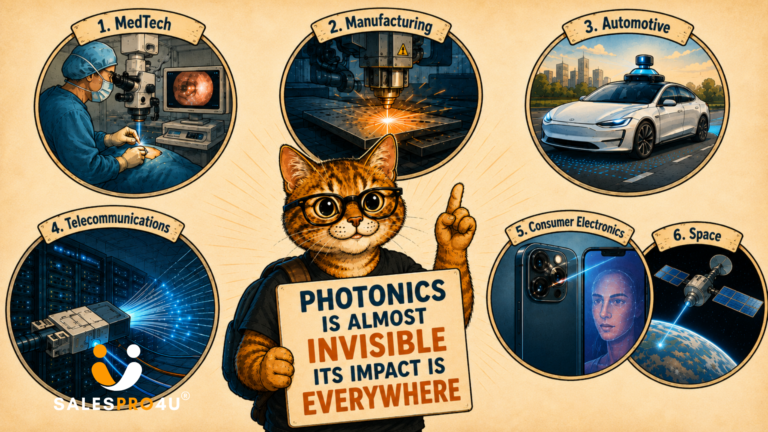
Photonics is almost invisible – compared to the massive role it plays in modern society.
We need to attract more people into the field. Once they experience the technology, they rarely leave because the work itself is not interesting enough.
8. The Future of Photonics
Vicky, SalesPro4U: What do you expect from the photonics industry over the next five years?
Adrian, OPTOTUNE: Photonics supports almost every major future technology trend. I therefore expect the industry to continue growing strongly.
OPTOTUNE is also on track for strong, double-digit growth in the coming years.
9. A Message to Future Professionals
Vicky, SalesPro4U: What would you say to professionals considering a career in photonics?
Adrian, OPTOTUNE: Photonics is an incredibly rewarding industry and offers a secure, long-term future – especially in hardware development.
Software is becoming increasingly automated, but developing advanced physical hardware requires deep and specialised human expertise.
For technicians and engineers, European photonics offers highly specialised technologies, valuable applications and excellent long-term career opportunities.
The future of hardware is bright.
A big thank you to Adrian for sharing such open and honest insights into leadership, culture and talent development at OPTOTUNE. It was a pleasure learning more about his perspective and the people behind the technology.
Get Your Company Featured Next!
Are you a company in photonics, MedTech, Deep Tech or semicon looking to showcase your technologies, company culture and open positions?
Join us for an upcoming episode of “The Company Special” and introduce your company directly to professionals and potential talents from our international network.
📩 Contact us at expert@salespro4u.com to become one of our next featured companies.
#SalesPro4U #OPTOTUNE #CompanySpecial #Photonics #MedTech #DeepTech #Semiconductors #Hiring #Leadership #CompanyCulture #OpenRoes #Careers
© 2026 SalesPro4U – text & concept; Images / Video: AI-generated.