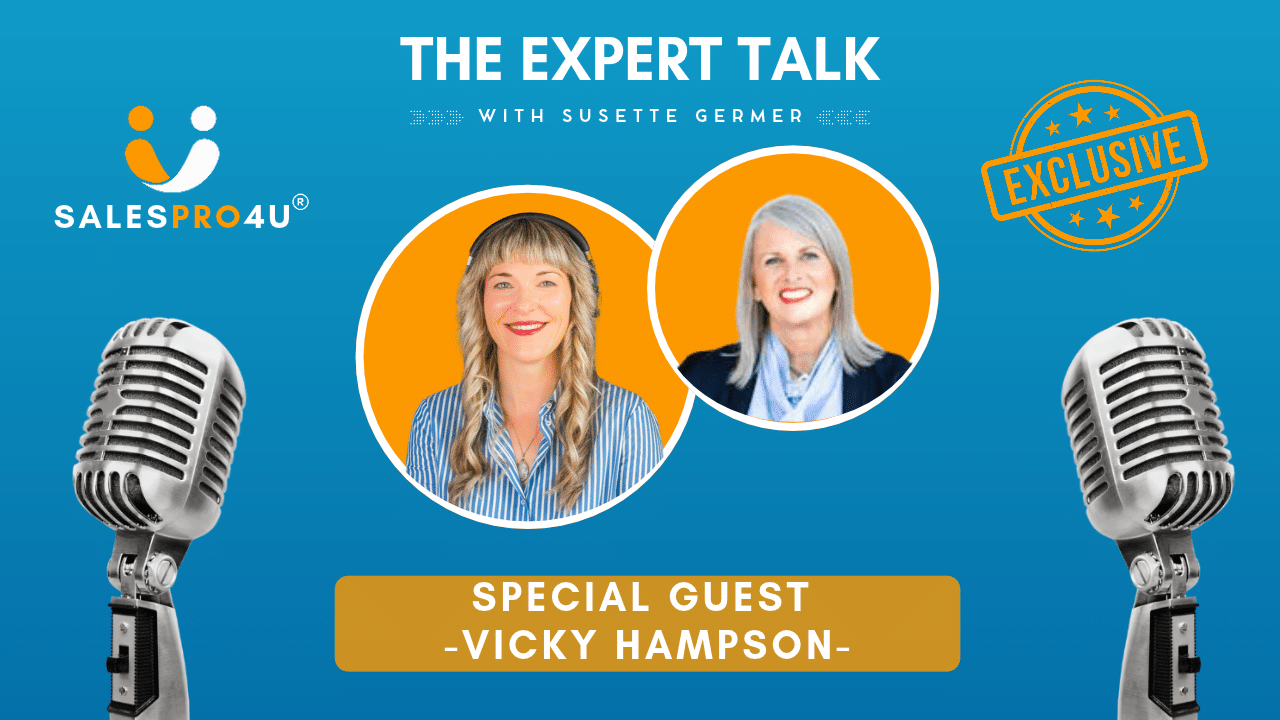
"From Lab to Boardroom: Key Skills Turning Scientists into Leaders" with Expert Vicky Hampson
Summary: In this episode of “The Expert Talk”, Global Commercial Leadership Consultant and Coach Vicky Hampson reveals why technical excellence alone is not enough to thrive in executive roles, how scientists and engineers can unlearn complexity to communicate business impact, and why high-performing leadership must be deliberately engineered rather than left to chance. Founder of Victorious Consulting and LoveSon, UK-born and Amsterdam-based Vicky brings 30 years of global commercial leadership across healthcare, technology, and highly regulated sectors. She specializes in partnering with engineering- and science-led businesses across photonics, semiconductors, medtech, and deep-tech to bridge the gap between technical expertise and commercial mastery. Driven by the conviction that “you can’t demand high performance, you have to engineer it,” she replaces off-the-shelf training with tailored capability building measured by real business outcomes.
Susette Germer, CEO of SalesPro4U, met Coach Vicky Hampson to discuss the transition from R&D to executive leadership, commercial mastery, and leading high-performing teams in science-driven industries.
Listen or watch the episode here: Spotify, iTunes, YouTube.
1. Why do Scientists and Engineers need deliberate capability building to become commercial leaders?
The answer is: because technical professionals receive years of rigorous scientific training and certification, yet rarely receive equivalent coaching or structured development when promoted into leadership roles.
Functional excellence is what builds innovative organizations, creates competitive advantage, and earns technical specialists their promotions. However, Vicky Hampson emphasizes that stepping out of the lab into commercial leadership requires a completely different set of capabilities. Without deliberate training, accomplished functional leaders often struggle to collaborate across departments, focusing solely on their own technical area rather than working together to grow the entire organization.
2. What quick, small successes can aspiring technical leaders aim for?
The answer is: mastering the art of simplicity, reframing technical milestones into customer impact, and building deep self-awareness.
Transitioning from detailed scientific analysis to executive communication requires unlearning the habit of explaining every complex detail and relearning how to deliver concise, outcome-driven messages. Vicky recommends three practical steps to build momentum:
- Master the art of simplicity: Distill complex technical facts into clear, concise business statements—summing up key points in six words instead of sixty-six without dumbing down the science.
- Reframe from the customer’s perspective: Instead of focusing on how long an R&D pipeline took or how complex the engineering is, highlight the tangible problem it solves for the patient, customer, or end user.
- Start with self-understanding: Recognizing your own values, behavioral triggers, and communication preferences provides the foundation needed to understand how others operate, model adaptability, and lead hybrid or cross-functional teams effectively.
3. What do leaders and companies lose if they don't invest in commercial leadership skills?
The answer is: they risk losing top scientific talent to executive frustration while suffering costly organizational missteps in forecasting, bidding, and customer retention.
Promoting brilliant scientists and hoping leadership skills transfer by osmosis carries both individual and organizational costs. On an individual level, newly promoted leaders can feel out of their depth when engaging with Chief Revenue Officers or presenting to a demanding board, eroding their confidence and gravitas until they eventually leave the company out of frustration. On an organizational level, lacking commercial rigor leads to poor bid decisions, inaccurate revenue forecasting, and preventable customer churn.
4. What Is Vicky’s best advice?
The answer is: apply your scientific mindset to leadership, treat high performance as something you deliberately engineer, measure, and validate through continuous feedback.
Rather than viewing commercial leadership as an abstract soft skill, Vicky encourages scientists and engineers to use their natural strengths in critical thinking and hypothesis testing. By seeking regular feedback from peers, mentors, and boards, technical leaders can continuously calibrate their approach, build resilience, and perform with as much confidence in the boardroom as they do in the lab.
5. Final Thoughts
Vicky Hampson’s insights show that bridging the gap from lab to boardroom requires moving beyond technical mastery to embrace clear communication, customer-centric reframing, and intentional leadership development. When science-led organizations invest in engineering these capabilities, both their leaders and their businesses achieve sustainable commercial success.
👉 Looking for support with your next career move, a new role in high-tech, or a leadership challenge? Or is your company looking to strengthen its HR practices, support employees, and develop talent? Through SalesPro4U, both professionals and companies can connect with experienced coaches and HR experts like Vicky Hampson, who offer practical guidance and personal support to help people and organizations grow.
Stay authentic. Stay bold. See you in the next episode of “The Expert Talk.”
#SalesPro4U #Coaching #CareerDevelopment #CommercialLeadership #Leadership #DeepTech #Photonics #MedTech #Semiconductors #STEMLeadership #ExecutiveCoaching #Podcast